
Know it's failing before it fails
Low-cost condition monitoring for domestic boilers. It learns what your boiler does when it is well, and sees it drift long before anyone could notice.
Not yet available. Join the list and we'll tell you when it is.
Industry has watched its machines for forty years. Your boiler has never been watched at all.
Condition monitoring is not new. In industry it is unremarkable. You instrument a pump, a turbine, a compressor; you learn what healthy looks like; you catch degradation long before it becomes failure. It works, it has worked for decades, and nobody argues about it.
It has never reached the boiler on your wall, and the reason is arithmetic. The sensing and the analysis have always cost more than the asset. Nobody puts a five-thousand-pound monitoring rig on a nine-hundred-pound combi.
So the most safety-critical machine in most homes is also the only one nobody watches. It runs until it stops.
Wide, dark, industrial: instrumented plant machinery in a plant room. Pumps or compressors with sensors and cabling visible. Cold, technical, unglamorous. The point of the image is the contrast with a domestic airing cupboard, so it should feel like a different world.
2000 × 1125Standard practice in industry. Unheard of in a domestic cupboard.
Stick it on. It starts learning.
Boiler Beacon adheres to the outside of the boiler casing. That is the whole installation. Nothing is opened, nothing is cut, nothing is wired in, and no engineer is needed.
It doesn't connect to the control board and it doesn't touch the gas path or the heating circuit, which keeps it out of the certification regime and independent of any manufacturer's protocol. It observes from outside. That constraint is the reason it can exist at this price at all.
From the moment it goes on, it starts building a picture of what that particular boiler does when it is well.
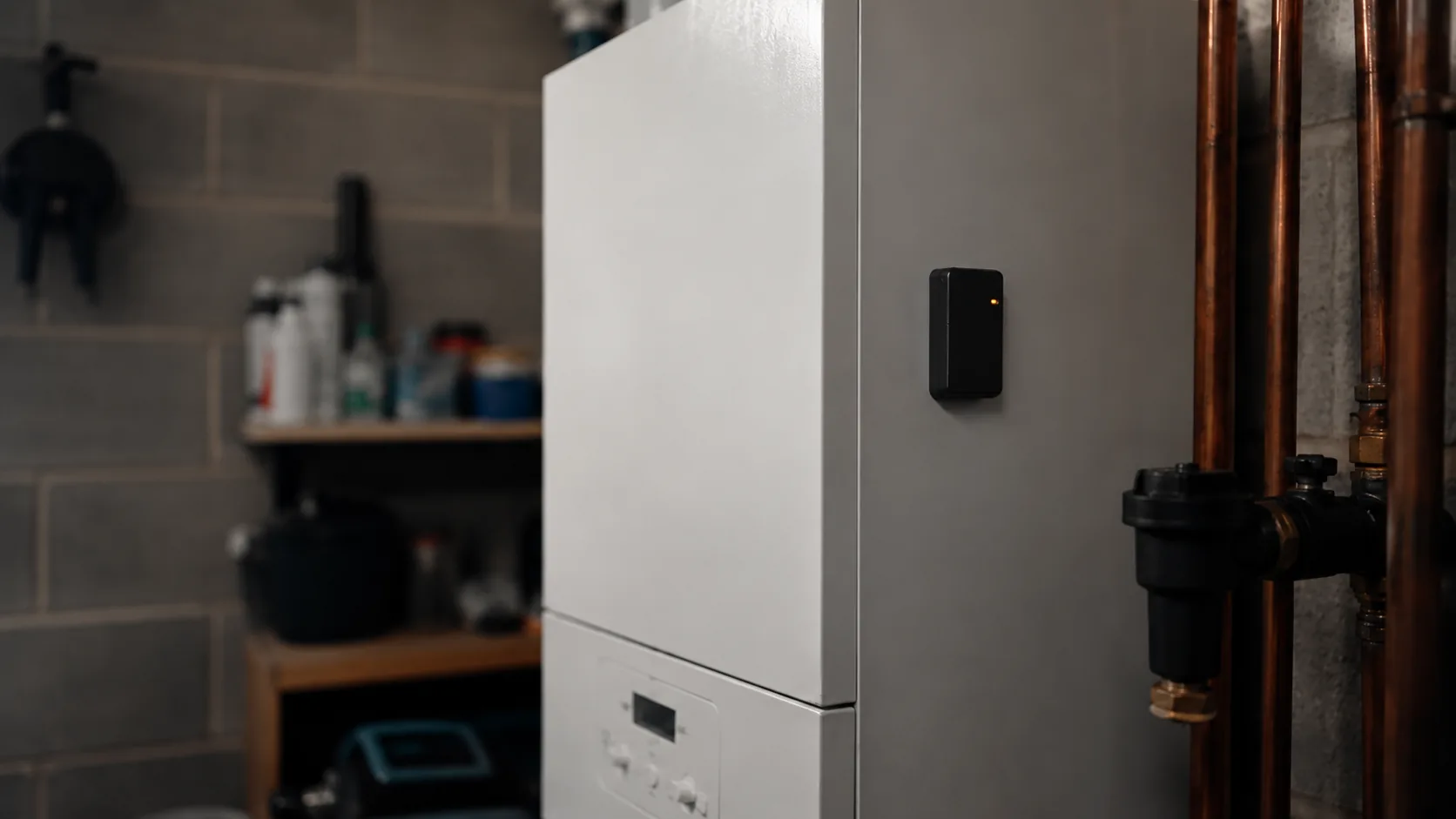
The entire installation. Nothing opened, nothing cut, no engineer.
The evidence sits in dimensions you cannot perceive
This is the part that matters, and it is the easiest to get wrong.
Boiler Beacon is not listening for a bad noise. A person can hear a bad noise. By the time there is one, the boiler is already announcing its own failure and the interesting window has closed.
What it builds instead is an abstract representation of the boiler's behaviour: a learned space with far more dimensions than a person has senses for. Degradation shows up as movement through that space long before it surfaces as anything anyone could name. Not a louder pump. Not a hotter case. A drift in the relationship between things, in a direction that has come to mean something.
The signal is real and it is there the whole time. It simply isn't in a form that human perception has any access to.
Abstract data visualisation, not a photograph and not a line chart. A high-dimensional space rendered as a dark field of points: a healthy cluster in muted grey-blue, and a trajectory drifting away from it in signal orange over time. It should look like a figure from a research paper, not a marketing deck. Dark background matching the site.
1800 × 1125Degradation as drift. The axes are not things a person could name.
Weeks of warning, not minutes of alarm
The output is not a red light that comes on once the boiler is already broken. That is an alarm, and an alarm is worth very little.
The output is time. Time to book a service on a Tuesday in October rather than an emergency callout on Christmas Eve. Time to plan a replacement instead of having one forced on you at the worst possible moment, at the worst possible price.
And when an engineer does come, they arrive with a record of what the boiler has actually been doing, rather than a householder's best recollection of a noise.
Portrait: a phone held in a hand, showing a clean technical readout. A health trend over weeks with a clear inflection point, not a red alarm screen. Dark UI, signal orange accent. The screen is the subject. Credible and restrained, not an app-store mockup.
1400 × 1750The product is the lead time.
One boiler is useful. Two hundred is a different business.
For a householder, the payoff is not being caught out.
For anyone responsible for a portfolio of boilers it is something else entirely. A landlord, a letting agent, a housing association, a facilities manager: hundreds of these machines, no way of knowing which of them are unwell, and a maintenance budget that gets spent reactively, at emergency rates, in the coldest week of the year.
Knowing in October which three of your two hundred boilers will fail this winter is worth considerably more than the devices cost.
Same technology, same device. The economics simply get more compelling the more boilers you are answerable for.
Portrait: a residential block or a row of housing association properties in flat winter light. Or a wall of boiler flues on the outside of a block. Cold, ordinary, unromantic. The subject is scale and responsibility, not architecture.
1400 × 1750Two hundred boilers. No idea which of them are unwell.
Every boiler it watches makes it better at reading the next one
A model built on one boiler knows one boiler. A model built on thousands starts to know what degradation looks like in general, and can recognise it earlier on a machine it has only just met.
That is the long game. The hardware is the same on day one and on day a thousand. What changes is how much it has seen, and therefore how early it can tell you something is wrong.
It is the opposite of a product that is finished the day it ships.
Honestly: it isn't finished
Boiler Beacon is in development. There is no product to buy, no pre-order, and no date we're willing to promise.
What there is: a principle that is proven everywhere except here, hardware being built and broken, and a question that is genuinely still open. How much of a boiler's condition is legible from the outside of the case? That is an empirical question, and it is being answered empirically.
If that interests you, leave an address. We'll tell you when there is something real to see, and we won't email you about anything else.
What people ask
Is this for spotting intermittent faults?
No, and the distinction matters. If a fault is intermittent, you have already noticed it. The boiler is announcing itself and most of the value has already gone. Boiler Beacon is condition monitoring: it looks for degradation while it is still imperceptible, well before anything surfaces that a person could notice.
What does it actually measure?
It builds a learned representation of how the boiler behaves and watches for drift in that representation. The useful signal is not any single measurement a person would recognise. It lives in the relationships between things, in a space with more dimensions than human perception has access to. That is exactly why someone standing in front of the boiler cannot see what it can.
Does it connect to the boiler?
No. It adheres to the outside of the casing. It does not connect to the control board, the gas circuit, or the boiler's own electronics, and nothing is opened to fit it. That constraint is what makes it fittable by anyone, without certification, and independent of any manufacturer's protocol.
How much warning does it give?
That is precisely what is being established, and we are not going to invent a number. Honestly: the warning available depends on the failure mode and on how much the model has already seen, and both of those improve over time.
Who is it for?
A householder who would rather not be caught out in January. And anyone responsible for a lot of boilers — landlords, letting agents, housing associations, facilities managers — for whom knowing which ones are unwell, before winter, is worth considerably more than the devices cost.
When can I buy one?
We don't know, and we're not going to invent a date. Join the list and you'll hear when there is something to see.
Be first to know
We'll email you when Boiler Beacon is ready, and nothing else. No newsletter, no marketing, no passing your address on.
One email, at launch. No newsletter. Unsubscribe isn't needed because there's nothing to unsubscribe from.